Unlock the Editor’s Digest for free
Roula Khalaf, Editor of the FT, selects her favourite stories in this weekly newsletter.
Chinese policymakers in search of a sugar rush for their finances might have found just the fix they need — a tax on sweet drinks that would net billions of renminbi a year and also bring Beijing into line with global norms.
China remains one of the last major economies without a nationwide tax on sugar-sweetened beverages. At least 116 countries had imposed national taxes on sugary drinks by mid-2024, according to the World Health Organization.
Days ahead of China’s annual rubber-stamp political meetings, officials are considering taxing beverages with the greatest sugar content, according to people familiar with the policy discussion. This would have the twin benefit of addressing a widening fiscal deficit alongside mounting public health challenges.
“Many countries, including India, have already implemented such measures, and China is unlikely to escape it,” said Yang Zhiyong, president of the Chinese Academy of Fiscal Sciences, a think-tank affiliated with the finance ministry. The proposal aligned with a global trend and was “fundamentally driven by the severe health challenges we face today”, he said.
High intake of added sugars, such as those in soft drinks, raises the risk of obesity and associated conditions such as cardiovascular disease, type-2 diabetes and some cancers, the WHO says. The organisation has repeatedly urged governments to deploy sugar taxes and restrict consumption to reduce health risks.
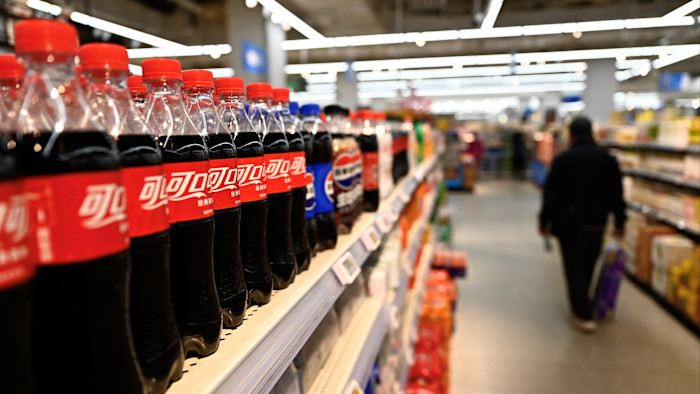
Last July, the WHO called on all countries to impose a tax equivalent to at least 20 per cent of the retail price of sugary drinks, with the aim of raising prices by 50 per cent by 2035. In China, a 500ml bottle of Coca-Cola typically retails for about Rmb3.5 ($0.50) while local brands, such as Eastroc’s Super Drink energy beverage, sell for Rmb3.
China’s latest food and nutrition guidelines, published in 2025, set a target of reducing average daily added sugar intake to no more than 25 grammes per person by 2030. Chinese authorities estimate average intake currently to be 30 grammes per person.
One proposal is to impose higher taxes on beverages with the most sugar content, according to people familiar with the policy discussion. If approved, the sugar levy is likely to become part of the existing consumption tax regime, allowing for fast implementation. The exact timeline for introduction is unclear.
Research published by Peking University and the Chinese Academy of Social Sciences in The Lancet Public Health in November estimated that a 20 per cent tax on sugary drinks between 2026 and 2050 could avert about 130,000 premature deaths and generate Rmb295.5bn ($43bn) in revenue over the 24 years. The study calculated broader economic benefits equivalent to 0.0016 per cent of China’s GDP.
China’s sugared beverage market is valued at about Rmb700bn, according to consultancy iiMedia Research Institute. Although sugar-free and low-sugar drinks have become more popular, annual sales are roughly Rmb61.5bn, less than a 10th of the sugared drinks market. A 500ml bottle of a sugar-free tea drink usually costs about Rmb3.
Coca-Cola is estimated by iiMedia Research to command roughly half of China’s sugar-sweetened beverage market, followed by Pepsi, Master Kong, Uni-President and domestic brand Eastroc Beverage. Coca-Cola, Pepsi, Master Kong, Uni-President and Eastroc did not respond to a request for comment. The finance ministry did not respond to a request for comment.
One person previously involved in the soft drinks industry in China said the possibility of “traffic light coding” was always in the discussion with regulators. This involves red packaging to indicate a high proportion of added sugar and green to indicate no sugar.
Yet policymakers may still struggle to convince consumers to put down their sugary drinks.
During China’s tough Covid restrictions, young people dubbed sugary drinks “happy fat water”, a phrase that conveyed the comfort they offered amid stress and social isolation.
Unless a very steep tax was imposed it was likely “to only have a limited impact on the end sales of sugary drinks like Coca-Cola”, said Zhang Yi, chief executive of iiMedia Research Institute. “Our studies show that people say they want sugar-free products, but when shopping, most still choose the sugary ones.”
“Consumers are perfectly clear-headed,” he added. “But their tongue is honest.”
Wu Jiejing, a Shanghai-based book editor, said she worried constantly about her son becoming overweight or developing diabetes, fears sharpened after a friend’s child was diagnosed with diabetes at 14 and later had to leave school.
“I’m absolutely against children drinking sugary drinks, but I can’t always resist them myself,” Wu said. “When you’re deep in writing, you just want a cup of milk tea or a Coke to keep you going.”
“I’m already trying to buy fewer sugary drinks,” she added. “But if health worries can’t make me cut back, a higher price probably won’t.”
With contributions from Thomas Hale in Shanghai and Cheng Leng in Beijing. Data visualisation by Haohsiang Ko in Hong Kong
Read the full article here